Security
Against AI agents, defense depends on where PHP runs
You still have to patch. But patching takes weeks and exploitation takes hours. WP2Vercel keeps WordPress in the private network, so the public site has no PHP to connect to. This page keeps the evidence, our inferences and the remaining risks separate.
WP2Vercel is currently in early access.

| Request | Response | |
|---|---|---|
| GET /wp-login.phpFind the login page | Find the login page | 404 |
| POST /xmlrpc.phpBrute-force passwords | Brute-force passwords | 404 |
| GET /wp-json/wp/v2/usersEnumerate accounts | Enumerate accounts | 404 |
| GET /author/admin/Enumerate authors | Enumerate authors | 404 |
| GET /wp-content/plugins/*/readme.txtFingerprint plugin versions | Fingerprint plugin versions | 404 |
| POST /wp-admin/admin-ajax.phpHit a plugin endpoint | Hit a plugin endpoint | 404 |
| GET /investors/q3-2026/Regular visitor | Regular visitor | 200 |
Every probe gets a 404 because these paths do not exist on the public site.
Where things stand
The most-used CMS, with most flaws in plugins
More websites run WordPress than any other CMS, which also makes it the largest target. Each of the four figures below has a scope, and we keep the qualifier next to the number.
- Share of all websites that use WordPress. Its share of the CMS market is 57.3%
- 38.4%
- W3Techs, 2026-11-24
- New vulnerabilities in the WordPress ecosystem in 2025, up 42% from 2024, counting every severity level
- 11,334
- Patchstack, 2026
- Vulnerabilities with no fix from the developer at public disclosure. Some were patched later
- 46%
- Patchstack, 2026
- Weighted median time from a protection rule going live to the first observed exploitation attempt, for heavily exploited vulnerabilities
- 5hours
- Patchstack, 2026
The 5-hour figure covers only the heavily exploited vulnerabilities, a group that accounts for about 95% of the exploitation activity Patchstack observed. It is not the median for all 11,334 vulnerabilities. Patchstack sells WordPress vulnerability protection products, and this is a vendor report.
What agents changed
AI now finds flaws and writes exploits
None of the four public sources below is about WordPress. We cite them to show what AI can already do in an attack workflow.
80-90%
In an espionage campaign disclosed by Anthropic, the attackers used AI to carry out 80 to 90 percent of the work, with humans stepping in at a few critical points. There were about thirty targets. Anthropic says the attackers succeeded in a small number of cases. The incident had nothing to do with WordPress.Anthropic, 2025-11-13
87% of 15
Given the CVE description, GPT-4 exploited 87% of the 15 one-day vulnerabilities the researchers tested. Without the description, it managed 7%. This is a 2024 preprint with a sample of only 15.Fang et al., arXiv:2404.08144
First public case
Google's Big Sleep team says that, to their knowledge, this is the first public case of an AI agent finding a previously unknown, exploitable memory-safety vulnerability in widely used software. The flaw was in SQLite. It was fixed the day it was reported and never reached an official release. Defenders made this finding, and it shows what the technology can do.Google Project Zero, 2024-10
15 techniques
Verizon's report says the median threat actor researched or used AI assistance in 15 documented techniques. The data covers all software and is not limited to WordPress.Verizon DBIR summary, 2026
Linking AI to the speed of WordPress vulnerability exploitation is our own judgment. None of the reports above reaches that conclusion, and neither does Patchstack's report.
WordPress core
In 2026, core joined the exploited list
In 2026 CISA added 4 WordPress core vulnerabilities to its Known Exploited Vulnerabilities catalog. According to CISA's descriptions, all four have a path to unauthenticated remote code execution, and two of them have to be chained.
| CVE ID | Date added | Description | Ransomware use |
|---|---|---|---|
| CVE-2026-60137 | 2026-07-21 | SQL injection. Can be chained with CVE-2026-63030 | Unknown |
| CVE-2026-63030 | 2026-07-21 | Interpretation conflict. Could allow SQL injection and remote code execution | Unknown |
| CVE-2026-87902 | 2026-09-25 | Remote file inclusion | Unknown |
| CVE-2026-119977 | 2026-11-03 | TOCTOU race condition during the upgrade window | Unknown |
A KEV listing means exploitation has been confirmed. It does not say how many sites were hit. All four entries show "Unknown" for ransomware use.CISA KEV, 2026-11-24 version
For 2025, Patchstack's report (updated 2026-02-25) says only 6 vulnerabilities were reported in WordPress core, all low priority. 91% of new vulnerabilities were in plugins and 9% in themes. The two sources cover different years, so read them separately.Patchstack, 2026
Hosting-layer defenses
Defenses in front of PHP stop a minority of attacks
Patchstack ran two penetration tests against hosting providers' defenses.
- First test: WordPress-specific vulnerability attacks blocked by hosting providers' defenses
- 12%
- Patchstack, 2026
- Second test: attacks blocked after the scope was widened to more vulnerabilities, including more generic types
- 26%
- Patchstack, 2026
This is a vendor's own test, and Patchstack sells the alternative. The test did not cover static or Headless output, so it supports one point only: a layer of defense in front of PHP is not enough. It cannot be used as an effectiveness figure for our architecture.
Before and after
What the public internet can reach, before and after
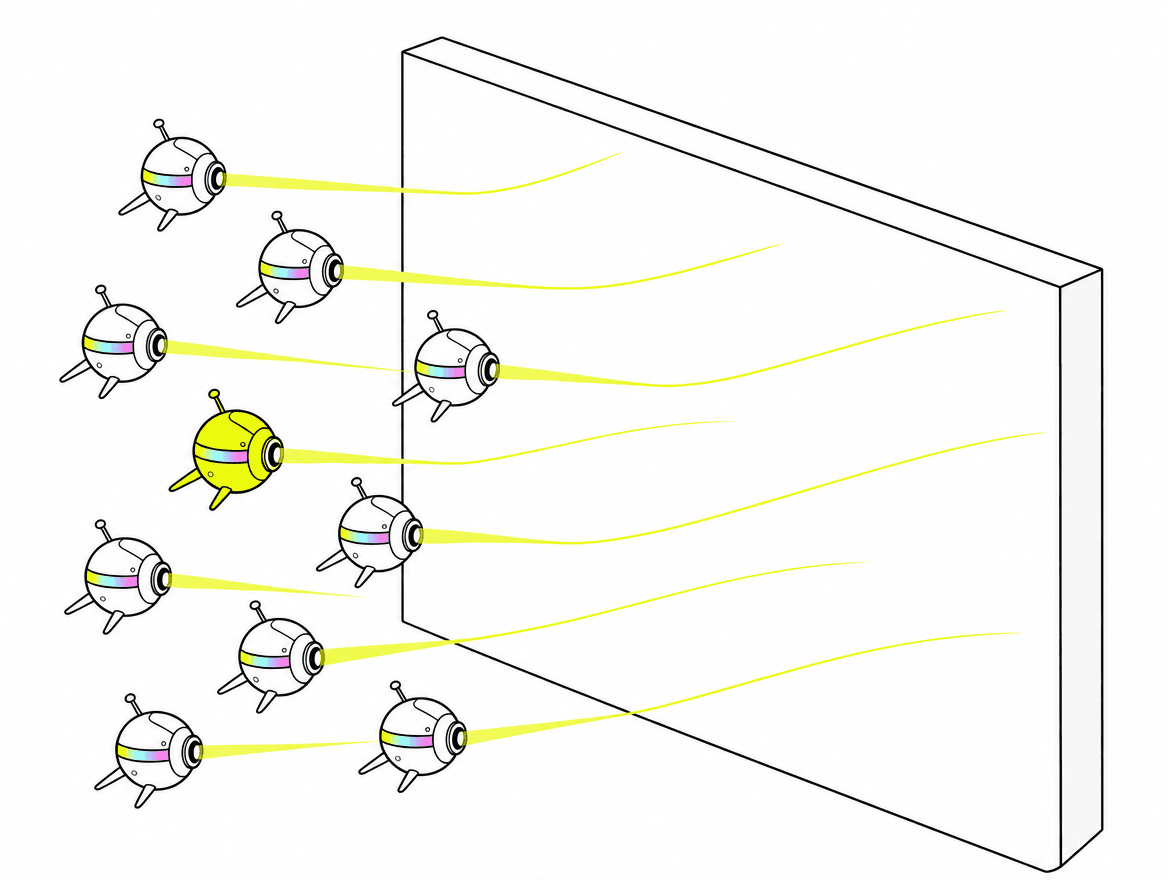
After conversion, the public site is only files on Vercel. Agents will still come to scan, but the paths they look for are not there.
Before conversion
The public internet connects straight to WordPress
- /wp-login.phpLogin pageReachable
- /xmlrpc.phpRemote callsReachable
- /wp-json/REST APIReachable
- /wp-admin/admin-ajax.phpPlugin endpointReachable
- /wp-content/plugins/*Plugin codeReachable
After conversion
The public internet connects only to Vercel
- /index.htmlPageStatic file
- /assets/*Styles and scriptsStatic file
- /wp-login.phpNot there
- /xmlrpc.phpNot there
- /wp-json/Not there
When this claim holds
- This is an architectural inference
- If the login page, xmlrpc.php and plugin endpoints are not on the public internet, their vulnerabilities cannot be reached from the public internet. The argument goes no further than that.
- There is no statistic to cite
- None of the sources we read measured the security effect of converting WordPress to static output. So this page will not give you a figure for how much risk it removes.
- The admin has to be isolated first
- If the origin still has a public IP, a staging domain or a public wp-admin, the plugin vulnerability figures above apply to it as before.
Remaining risks
Public PHP is gone. Other risks remain
This architecture addresses the PHP and plugin attack surface on the public internet, and only if the origin is already isolated. The nine risks below do not go away with conversion. For each one we give the reason, how far the software goes and what your team has to do.
| Risk | Why it remains | What the software does, what your team does |
|---|---|---|
| The origin itself | Editors still have to sign in somewhere, and plugin vulnerabilities are still present. An attacker now has to pass access verification before reaching them. | Updating plugins, themes and core is still your team's job. WP2Vercel does not update the origin. The origin isolation check in the Team plan probes from outside to see whether wp-login.php, xmlrpc.php and wp-json are still reachable. Every plan checks the output files for the admin domain. The full leak scan, from Pro up, blocks the publish when it finds one. |
| Stolen credentials | If any one set of credentials leaks (an editor account, Git, Vercel or DNS), an attacker can change content or repoint the domain. Phishing aimed at editors belongs here too. | The plugin's Git token needs write access only to the preview branch. The Team plan checks that the token scope and main branch protection are set correctly. SSO, MFA and account management are your team's responsibility. |
| Malicious scripts in content | If malicious content is already in the database, static export publishes it unchanged. | The leak scan looks for traces such as the admin domain and REST API links. It does not judge whether a script is malicious. The named approval workflow in the Team plan puts a person in front of each publish. Content review is your team's job. |
| Third-party JavaScript and dependencies | Analytics tools, tag managers and build-time packages sit outside this architecture. If one is compromised, visitors are affected the same way. | WP2Vercel does not inspect third-party scripts. The inventory step of the launch gates asks you to list the purpose and owner of every script. Your team removes the ones that are no longer used. |
| APIs that replace dynamic features | Forms, search, comments, memberships, checkout and preview need APIs or serverless functions. These are new attack surface. | From Pro up, the plugin provides replacements for forms and site search. For any other API or serverless function you add, your team owns authentication, input validation and updates. The inventory step of the launch gates asks you to list each one. |
| Server-side code in a Headless front end | On 2025-12-03 React disclosed CVE-2025-55182, an unauthenticated remote code execution vulnerability in React Server Components, rated CVSS 10.0. Pure static files do not run this kind of code. A Headless front end does.React, Critical Security Vulnerability in React Server Components, 2025-12-03 | Static output is not affected by this class of vulnerability. In Headless mode (Team and up), your engineering team or partner builds the front end and is also responsible for updating its dependencies. |
| The Vercel platform itself | Vercel reported a security incident in April 2026: unauthorized access to certain internal systems, which originated with a compromise of Context.ai, a third-party AI tool used by a Vercel employee. Non-sensitive environment variables stored on Vercel were compromised for a limited subset of customers. Vercel says none of its own npm packages were compromised and that the incident was closed on 2026-10-16.Vercel, April 2026 security incident | The site is deployed in your own Vercel account. Keep only the secrets you need in environment variables and rotate them regularly. That is your team's job. A public site built from static output usually needs no secrets. |
| Your side of shared responsibility | Vercel uses a shared responsibility model. The customer handles their data, applications and user access management. That includes source code, environment variable exposure, IAM configuration, long-term log retention, and any costs and resource consumption caused by malicious traffic.Vercel Docs, Shared Responsibility Model | WP2Vercel is software you install. It does not take on the responsibilities Vercel assigns to customers. The Git, Vercel and DNS accounts are yours, and your team is responsible for their configuration and log retention. |
| Compliance certifications do not transfer | Vercel's SOC 2 attestation and ISO certifications cover the Vercel platform. They do not cover your site, WP2Vercel or Tenten.Vercel Docs, Security & Compliance Measures | WP2Vercel and Tenten do not claim these certifications. An audit looks at evidence of your own controls. The Team plan can export the audit log, and the Enterprise plan provides procurement and security questionnaire documents. |
The plugin itself
Three facts about the plugin's own security
WP2Vercel is a plugin too, and it can have vulnerabilities like any other. This section lists only what is true today. We have no third-party audit report or certification to offer at this point.
Source code you can inspect
The Community core will be published on GitHub under an open-source license. Once it is public, anyone can read the code and confirm for themselves what the plugin does.
The token needs write access only to the preview branch
The Git token the plugin uses to push content needs write access only to the preview branch. With the main branch protected, an attacker who compromises the origin cannot use this token to change production.
A channel for reporting vulnerabilities
If you find a vulnerability in WP2Vercel, report it through the contact page. Include the affected version or component and the steps to reproduce it.
Report a vulnerability
Tenten's public data
We track these vulnerabilities routinely
Both are public reference tools that anyone can search.
Tenten vulnerability log
Lists vulnerabilities that CISA confirmed as exploited in 2026, with product, CVE, severity, fixed version and source. Reviewed weekly.
tenten.co/securityKEV Patch
A searchable directory of the CISA KEV catalog that adds affected versions and vendor fix information to each record.
kevpatch.com

Take WordPress off the public internet
Leave your email and we will tell you when the paid plans open. The free edition will be published on GitHub and needs no license key.
Joining the early access list is free.